
Nanometer Precision Motion
Piezo Stages, Nano-Positioners, Scanners
Piezo stages provide highly precise, fast-response motion for microscopy, semiconductor manufacturing, optics, photonics, metrology and other applications where nanometer-level positioning is required.
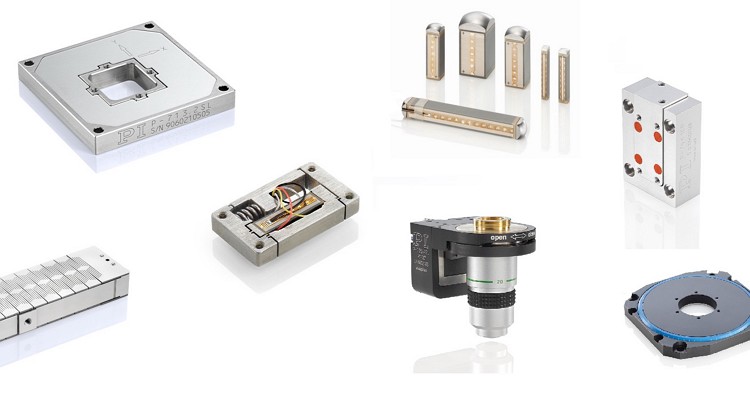
What is a Piezo Stage and What is it used for?
A piezo stage, short for piezoelectric stage, is a highly precise positioning mechanism that uses the piezoelectric effect for accurate movement with resolution down to the nanometer range and below. The piezoelectric effect involves the generation of electric charge in response to mechanical stress and, conversely, controlled motion when an electric field is applied. Different types of piezo stages are optimized for longer travel, higher precision, higher dynamics or greater force.
In a piezo stage, one or more piezoelectric elements are usually integrated into the mechanical structure of the stage. When voltage is applied to the piezoelectric elements, they undergo minute deformations or expansions. These controlled changes create continuous, extremely fine motion for ultra-high precision positioning.
Piezoelectrics can also be used for sensing and as transducers with nanometric motion operating in the ultrasonic or even MHz range.
Piezo stages are known for high resolution, rapid response and exceptional precision, making them suitable for microscopy, semiconductor manufacturing, optics and other areas where precisely controlled motion is crucial. Due to their nanometer-precise positioning capability, these stages are also sometimes called nanopositioners. Piezoelectric stages are sometimes used together with other motion control components, such as linear motors in hybrid systems, to combine long travel with very fine adjustment.
Performance Advantages of Piezo Stages
Piezo stages provide advantages when very smooth motion with nanometer and subnanometer resolution is required. Piezoelectric nanopositioning stages are also superior to many motor technologies in step-and-settle behavior and fast scanning. Millisecond and even microsecond response is feasible with a well-designed piezo flexure stage.
Piezo motion stages work well in vacuum and can be manufactured with non-magnetic materials because the ceramic drive material itself is non-magnetic. PI is a world leader in piezo stage design with five decades of experience. PI's piezoelectric transducers have been life-tested for 100 billion cycles by JPL/NASA for the Mars Mission.
Applications of Piezo Stages
Piezo stages are used in microscopy, semiconductor inspection, photonics alignment, optical testing, nanometrology, and precision manufacturing. Their nanometer-level motion, fast response, and smooth scanning capability make them ideal for positioning lenses, samples, fibers, probes, mirrors, and sensors where conventional motorized stages cannot provide sufficient resolution or stability. For high-load and long-travel 6-axis applications, hexapod robots are recommended.
Piezo Flexure Stages, Piezo Motors and Long-Travel Positioners
In addition to classical piezo flexure stages, PI also offers several types of piezo motors and piezo motor positioners with long travel ranges to 100 mm and more. Read this article on different piezo motor principles to learn how to select the right piezo motor or stage depending on the main priority, such as speed, force, resolution or cost.
See examples below, and click on the image for further details. PI's piezoceramic design and manufacturing division, PI Ceramic, specializes in piezoelectric transducers and ultrasound transducers.
Examples of Piezo Stages
 Microscope Stages / Z-Motors
 Multiaxis Piezo Stages
 Z-Piezo Stages / Actuators
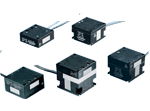 Compact X / XY / XYZ Systems
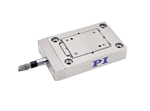 Single Axis Piezo Stages
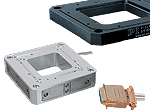 Piezo Stage with Aperture
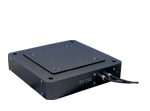 6-Axis Piezo Stages
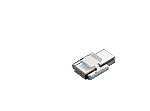 Mini Piezo Motor Stages
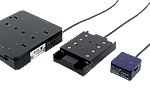 Piezo Motor Linear Piezo Stages
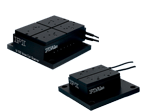 Scanning Stages with Voice Coil Drive
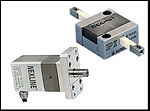 NEXLINE® / NEXACT® High Force Piezo Motor Actuators
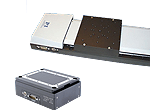 Hybrid Piezo Actuators, Astronomy
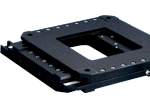 Open-Frame XY Piezo-Motor Stage
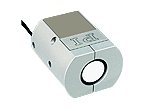 Piezo Mirror Platforms
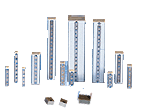 Piezo Stacks
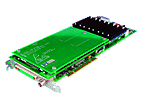 OEM Piezo Controllers
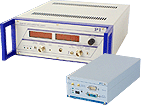 1-Channel Piezo Controllers
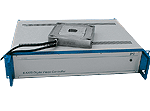 Digital Piezo Controllers
Piezo Stages vs. Motorized Stages
Piezo stages and motorized stages solve different precision motion problems. Piezo flexure stages are preferred when nanometer or subnanometer resolution, fast response, smooth scanning and very high stability are required over short travel ranges. Motorized stages are better suited for longer travel, larger work envelopes and coarse positioning tasks. In many high-performance systems, both technologies are combined: a motorized stage provides long-range positioning, while a piezo stage performs the final fine motion, scanning or active stabilization.
| Stage Type | Best Use | Strengths | Typical Limitations |
|---|---|---|---|
| Piezo Flexure Stages | Nanopositioning, microscopy, photonics alignment, semiconductor metrology, AFM, fast scanning and active vibration or drift compensation. | Nanometer and subnanometer motion, very fast settling, frictionless flexure guidance, no backlash, excellent repeatability and smooth continuous motion. | Travel is usually limited to micrometers or a few millimeters; requires a piezo controller or amplifier; payload and travel must be matched carefully to the flexure design. |
| Linear Motor Stages | Long-travel precision positioning, high-throughput automation, wafer inspection, laser processing, optical metrology and production systems. | High speed, high acceleration, long travel, no mechanical screw drive wear and good dynamic performance when paired with precision guides and encoders. | More complex servo tuning, higher system cost than simple screw stages, heat and cable management considerations, and usually lower fine-motion resolution than piezo flexure stages. |
| Voice Coil Stages | Fast focus, short-stroke scanning, vibration control, optical tracking, Z motion and dynamic positioning with moderate travel. | Smooth direct drive motion, high bandwidth, good force control and longer stroke than many classical piezo stack flexure stages. | Requires continuous current to hold position unless mechanically balanced; can generate heat; generally larger than compact piezo stages and depends strongly on feedback control. |
| Screw-Driven Stages | General laboratory positioning, machine setup, low-cost automation, larger travel ranges and applications where speed and nanometer-level dynamics are not the primary requirement. | Cost-effective, robust, available in many travel ranges and load classes, often self-locking depending on screw type and drive design. | Mechanical contact can introduce friction, wear, backlash, stick-slip, lower scanning smoothness and slower step-and-settle behavior compared with direct-drive or piezo systems. |
Selection guideline: Choose a piezo stage for the final nanometer-level motion. Choose a linear motor stage for fast, long-travel precision motion. Choose a voice coil stage for dynamic short-stroke motion with more travel than many piezo flexure stages. Choose a screw-driven stage when cost, travel range and holding force matter more than ultra-smooth nanopositioning.